
Nitrogen gas booster pumps: industrial applications and when higher pressure is needed
Nitrogen is widely used in industrial processes due to its properties as an inert gas under normal operating conditions. Common applications include pressure testing, leak testing, hydraulic accumulator pre-charging, and systems that require controlled atmospheres.
However, having a nitrogen supply does not necessarily mean having sufficient pressure for every application. In some installations, the pressure available from supply cylinders or nitrogen generators is lower than the process requires. In others, supply pressure decreases during operation and eventually becomes insufficient to complete the task.
In these situations, a nitrogen compressor may be needed to increase the available gas pressure. One solution is a nitrogen gas booster pump, also known as a nitrogen booster, designed to raise the pressure of gas that is already pressurized.
The need for additional compression depends on the application. Pressurizing a component for leak testing, pre-charging a hydraulic accumulator, and storing nitrogen from an on-site generator involve different operating requirements. Each process has its own pressure, flow rate, gas quality, and operating conditions.
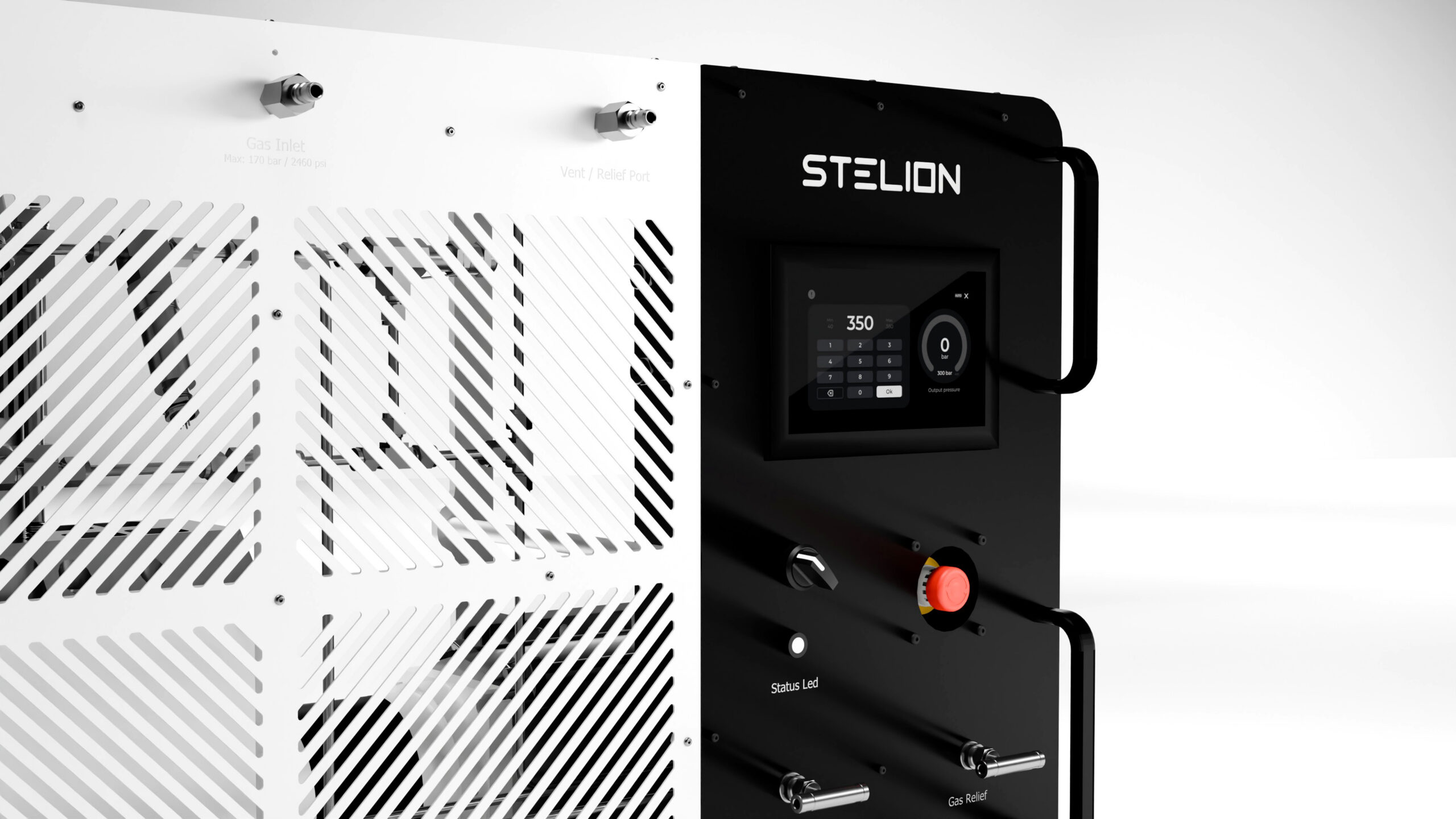
Close-up of the STELION Booster Station gas booster control panel and pressure relief valve
When is a nitrogen compressor or booster needed?
A nitrogen booster is useful when the available supply pressure cannot reach or maintain the conditions required by an industrial application.
In systems supplied by compressed gas cylinders, pressure decreases as nitrogen is consumed. When the pressure in the receiving vessel approaches the supply pressure, direct gas transfer becomes progressively less effective until the pressures reach equilibrium. This may prevent an operation from being completed even though nitrogen remains in the supply cylinder.
In other situations, the limitation lies in the nitrogen source itself. A nitrogen generator may deliver gas at the required purity and flow rate but at a pressure below that needed for storage or downstream use. A booster introduces an additional compression stage between the supply and the point of use, provided that the inlet conditions and operating requirements are compatible with the equipment.
However, not every nitrogen installation requires an additional compressor. If the existing supply provides sufficient pressure and flow capacity, an additional compression stage may be unnecessary.
For a more detailed explanation of the technology, see our guide on what a gas booster pump is and how it works.
Industrial applications of nitrogen gas boosters
Nitrogen compression is used across different industrial sectors. Common applications include pressure testing, hydraulic accumulator pre-charging, nitrogen generation systems, and manufacturing processes that require gas at higher pressures.
In each case, the role of the booster and the technical requirements of the system are different.
Nitrogen pressure testing and leak testing
Pressure testing is used to evaluate the behavior of components and systems under specified operating conditions. Leak testing, meanwhile, aims to determine whether leakage exceeds the limits established for a particular application.
Nitrogen can be used as a test gas for components such as valves, fittings, pipelines, pressure vessels, and industrial assemblies. In these installations, a nitrogen gas booster pump may be required when the available supply pressure is lower than the specified test pressure.
For example, a test bench may use nitrogen cylinders as its gas supply. As successive tests are performed, the available cylinder pressure decreases. An additional compression stage allows the remaining gas to be used at a higher pressure, provided that the operation remains within the authorized test conditions.
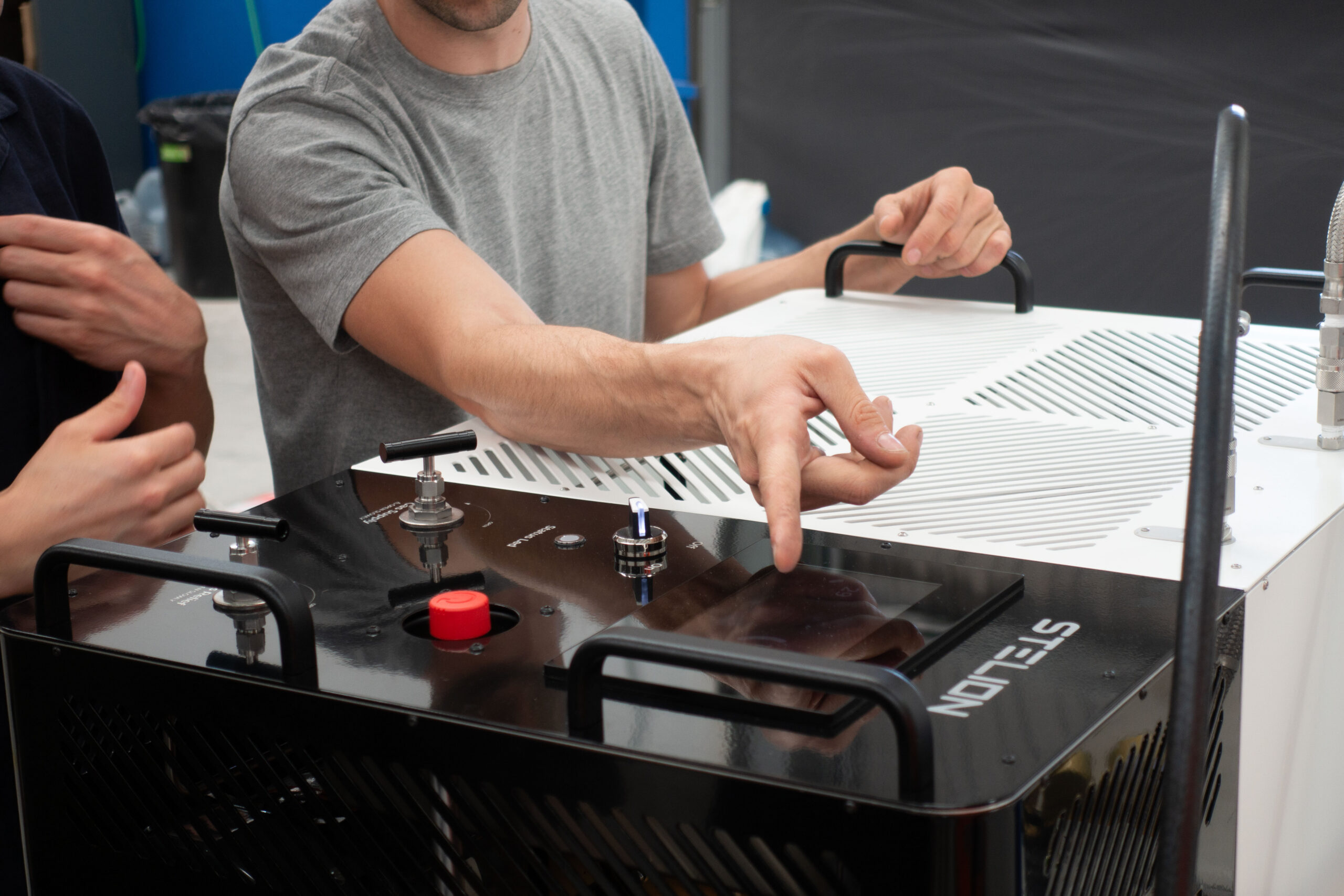 STELION Booster Station undergoing a nitrogen gas compression test
During a pressure strength test, the objective is to verify that a component withstands the conditions defined by the test procedure. In a leak test, the aim is to detect or quantify leakage using an appropriate measurement method.
Therefore, beyond maximum pressure, engineers must consider the test circuit volume, required pressurization rate, pressure stability, and measurement and control systems.
Hydraulic accumulator pre-charging with nitrogen
Hydraulic accumulators use compressed gas to store energy or compensate for changes in pressure and volume within a hydraulic circuit.
Many bladder, diaphragm, and piston accumulators use dry nitrogen as their pre-charge gas. The initial gas pressure affects accumulator behavior and must be set according to the manufacturer’s specifications and the system’s operating conditions.
During commissioning or maintenance, this pressure may need to be checked and adjusted. When a nitrogen cylinder provides pressure above the required pre-charge level, the accumulator can be charged using suitable charging and regulating equipment without additional compression. However, if the available supply pressure is insufficient, a nitrogen booster pump can provide the additional compression needed to complete the operation.
Boosting nitrogen pressure from on-site generators
Some industrial facilities produce nitrogen directly at the point of use using technologies such as Pressure Swing Adsorption (PSA) or membrane separation.
These systems extract nitrogen from air, but the available pressure and flow rate depend on the technology, configuration, and operating conditions.
It is important to distinguish between a nitrogen generator and a nitrogen compressor. While the generator separates nitrogen from air, the compressor increases the pressure of the available gas. The two devices perform different functions and can be used together.
In some applications, the generator’s outlet pressure is sufficient to supply the process directly. In others, particularly when high-pressure storage is required or peak demand exceeds the instantaneous production capacity, an additional compression stage may be necessary.
However, a nitrogen booster increases gas pressure; it does not generate nitrogen or improve its purity. System integration must consider the quality of the nitrogen supplied, moisture content, available flow rate, and the generator’s operating limitations. If the booster demands more gas than the source can deliver, the inlet pressure may fall and disrupt the intended operating conditions.
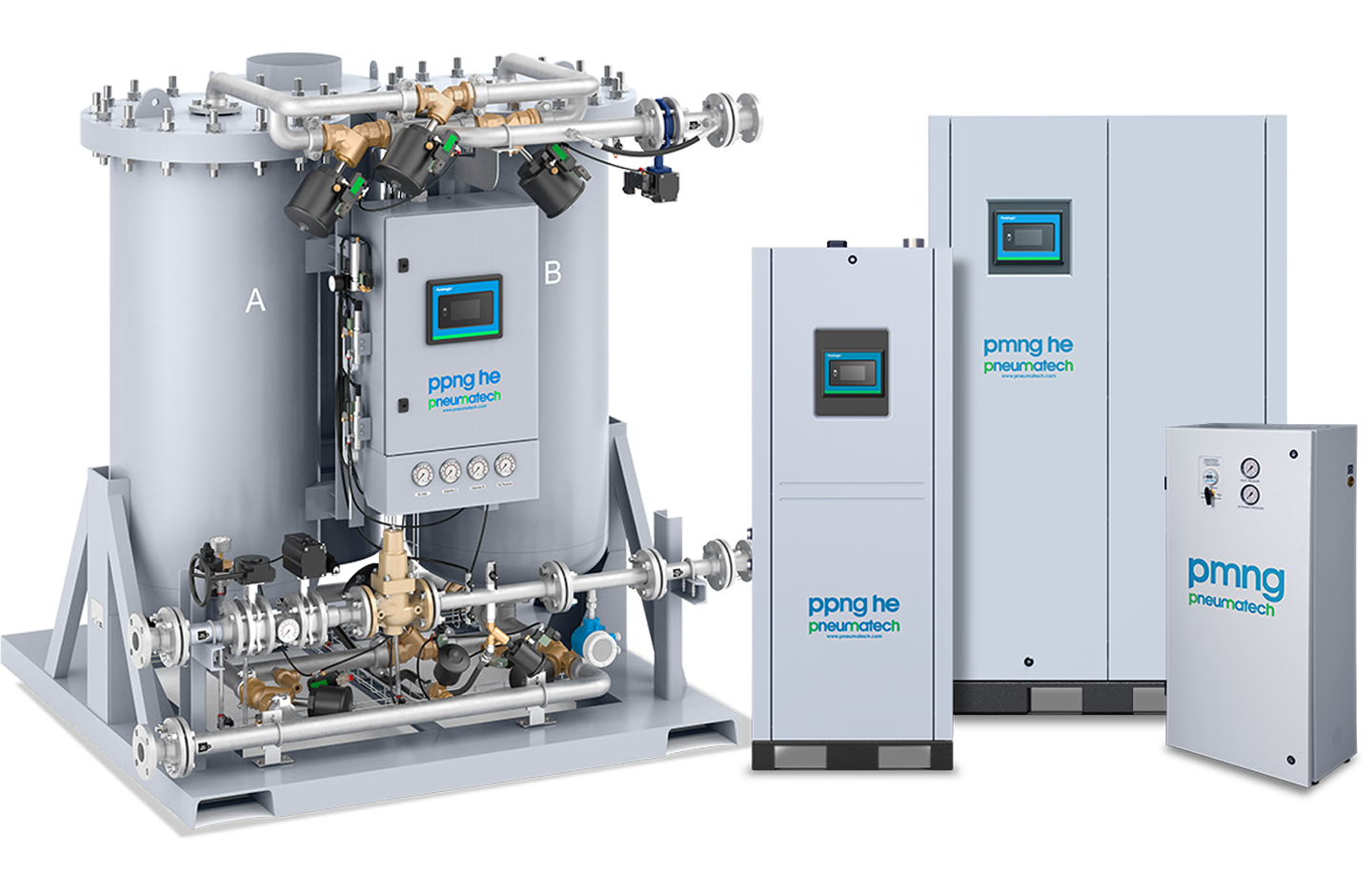
On-site nitrogen generation systems from Pneumatech’s PPNG HE range. Image credit: Pneumatech.
Other industrial processes requiring high-pressure nitrogen
Beyond these applications, some industrial processes require nitrogen at a specific pressure to perform their intended function.
One example is certain sealing systems that use nitrogen as a barrier gas. Depending on the configuration, the barrier gas pressure must remain within a specified range relative to the process fluid pressure. A compression system may form part of the installation responsible for maintaining the required supply conditions.
Another application is gas-assisted injection molding, where nitrogen is introduced during specific manufacturing stages to help form particular geometries in molded components.
Other uses include vessel filling, supplying industrial test benches, and storing pressurized nitrogen for industrial processes.
By contrast, many inerting, purging, and controlled-atmosphere applications operate at relatively low pressures and do not necessarily require a booster.
Comparison of industrial applications
Although these applications may all require pressurized nitrogen, their operating requirements are not identical.
| Application | Main requirement | Critical system considerations |
| Pressure and leak testing | Reach a specified test pressure | Target pressure, volume, pressurization rate, and control |
| Hydraulic accumulator pre-charging | Set the required pre-charge pressure | Required pressure, connection compatibility, and temperature |
| Nitrogen generation systems | Increase pressure for storage or downstream use | Inlet pressure, available flow rate, and gas quality |
| High-pressure industrial processes | Maintain the required supply conditions | Process pressure, gas demand, and operating duty |
These differences explain why selecting a nitrogen compressor or booster must begin with the requirements of the application rather than the maximum pressure rating of the equipment.
Technical requirements for selecting a nitrogen gas booster pump
To determine whether a nitrogen booster is suitable for an installation, the actual gas supply and operating conditions must be evaluated.
The first parameter is inlet pressure. Knowing the nominal supply pressure is not enough; the minimum expected pressure during operation must also be established. This is particularly important when nitrogen comes from cylinders whose pressure decreases as gas is consumed.
The outlet pressure must meet the process requirements while remaining within the design limits of every component in the installation.
Another important factor is the required flow rate. Some applications need a specific quantity of gas to be delivered within a defined period. In others, the priority is reaching a target pressure and maintaining it under specified conditions.
Booster performance may vary depending on inlet pressure, outlet pressure, and equipment configuration. Therefore, a high maximum pressure rating does not guarantee that the required flow rate can be maintained throughout the operation.
Operating frequency also influences equipment selection. A test bench used occasionally has different requirements from an industrial process with frequent or prolonged gas demand.
Finally, nitrogen quality requirements must be evaluated, particularly purity, moisture content, and potential contaminants, together with compatibility with the compression system’s internal components.
Integrating a nitrogen gas booster pump into an industrial installation
A nitrogen booster forms part of a wider gas supply, compression, control, and utilization system.
The system architecture depends on the nitrogen source and the intended point of use. It may include commercial gas cylinders, a nitrogen generator, intermediate storage, instrumentation, and process equipment.
The installation must incorporate the isolation, regulation, measurement, and protective devices required by its design.
Temperature changes associated with compression must also be considered. Depending on the allowable temperatures for the application, gas conditioning may be necessary before storage or downstream use.
Another consideration is the drive technology. Electric gas boosters provide compression without relying on an external compressed air supply, while pneumatic systems have different integration requirements.
The differences between these technologies are covered in our article on electric vs. pneumatic gas boosters.
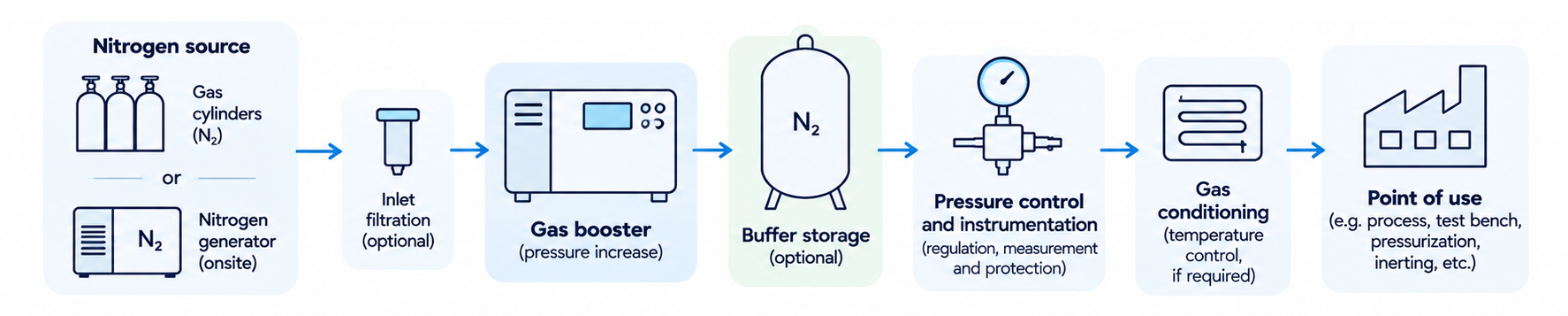
Technical diagram showing nitrogen gas booster integration with gas supply, optional storage, pressure control, gas conditioning, and industrial equipment.
Safety considerations for high-pressure nitrogen systems
Although nitrogen is non-flammable and generally inert, its use is not without risks.
High-pressure systems store energy that can be released dangerously if a vessel, connection, or component fails.
In addition, a nitrogen leak can displace oxygen from the surrounding atmosphere and create hazardous conditions, particularly in enclosed or poorly ventilated spaces.
The European Industrial Gases Association (EIGA), in its publication Hazards of Oxygen-Deficient Atmospheres, addresses the risks associated with oxygen-deficient atmospheres and the preventive measures that should be considered when working with inert gases.
Testing applications must also account for stored energy, physical protective measures, and the specific procedures required for working with compressed gases.
Selecting a compressor compatible with nitrogen does not replace the risk assessment or technical validation of the complete installation.
STELION Booster Station: electric nitrogen gas booster pump for industrial applications
STELION Booster Station is a family of compact electric gas compression systems developed by Hydros Power for hydrogen and other industrial gases, including nitrogen.
Its electric drive enables gas compression without relying on an external compressed air supply. It also incorporates a digital interface for configuring operating conditions and monitoring the compression process.
STELION Booster Station can be used in the industrial nitrogen compression applications described in this article, from pressure and leak testing to hydraulic accumulator pre-charging, compression downstream of nitrogen generation, and other industrial processes requiring gas at a pressure higher than the available supply pressure.
Its compact design makes it suitable for consideration in test benches, industrial installations, and nitrogen supply systems where an electric compression stage is required.
The range includes different configurations to accommodate varying inlet pressures, outlet pressures, flow rates, and operating conditions.
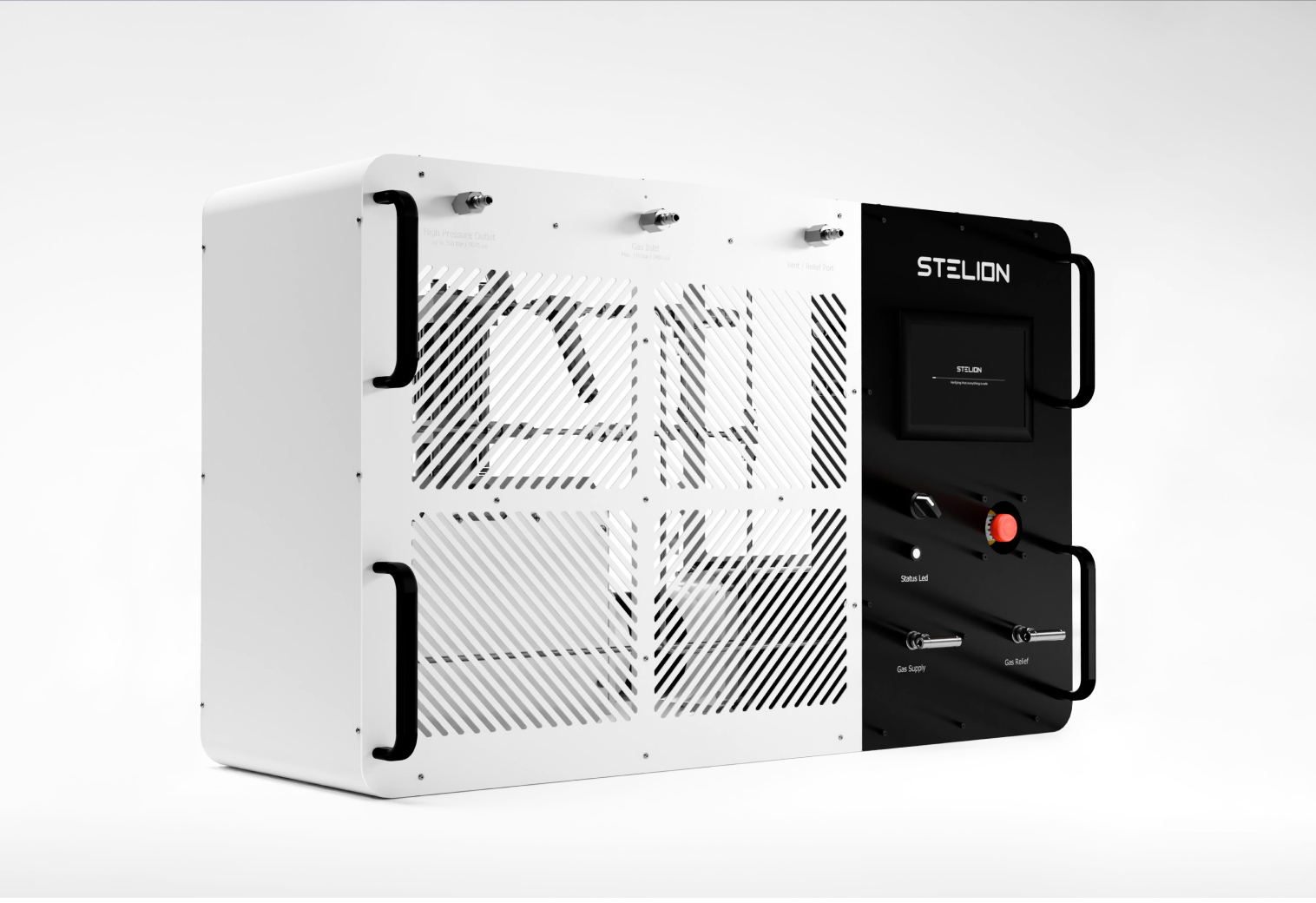
STELION Booster Station, an electric gas compression solution
Do you need to increase nitrogen pressure in your installation?
Hydros Power offers STELION Booster Station, an electric gas compression solution for industrial nitrogen applications, with different configurations to meet the requirements of individual projects.
If you need to increase the pressure of your nitrogen supply, explore the specifications of STELION Booster Station or contact our team to discuss your application.
Recent articles
November 20, 2026
Nitrogen gas booster pumps: industrial applications and when higher pressure is neededOctober 27, 2026
Hydrogen cylinder filling with a gas booster pump: pressure, flow rate and system designOctober 20, 2026
Hydros Power launches €250,000 bridge funding round to support its next stage of industrial growthOctober 19, 2026
Hydros Power introduces STELION Gas Cooler for post-compression hydrogen coolingSeptember 24, 2026
Hydrogen Refueling for Drones and UAVs: Challenges and Solutions


Press contact
For press inquiries or additional information about Hydros Power and its hydrogen solutions, you can contact the team at:
Guillermo Megías Collado
guillermo.megias@hydros-pwr.com
+34 865 642 254
03008, Alicante (Spain)
28020, Madrid (Spain)


