
Electric vs Pneumatic Gas Boosters: Key Differences and How to Choose
Gas boosters are essential equipment in any operation that requires transferring, compressing or storing gases under pressure. Their function is as simple as taking a gas at a given pressure and raising it to a higher pressure to feed a fuel cell system, fill a tank or complete a refueling process for UAVs, AGVs or similar applications.
What is not so simple is choosing the right drive technology. For decades, pneumatic gas boosters have dominated the market thanks to their mechanical simplicity and ability to operate without electrical components. However, the emergence of electric gas boosters has opened up an alternative that offers significant advantages in efficiency, automation and control, particularly in hydrogen applications.
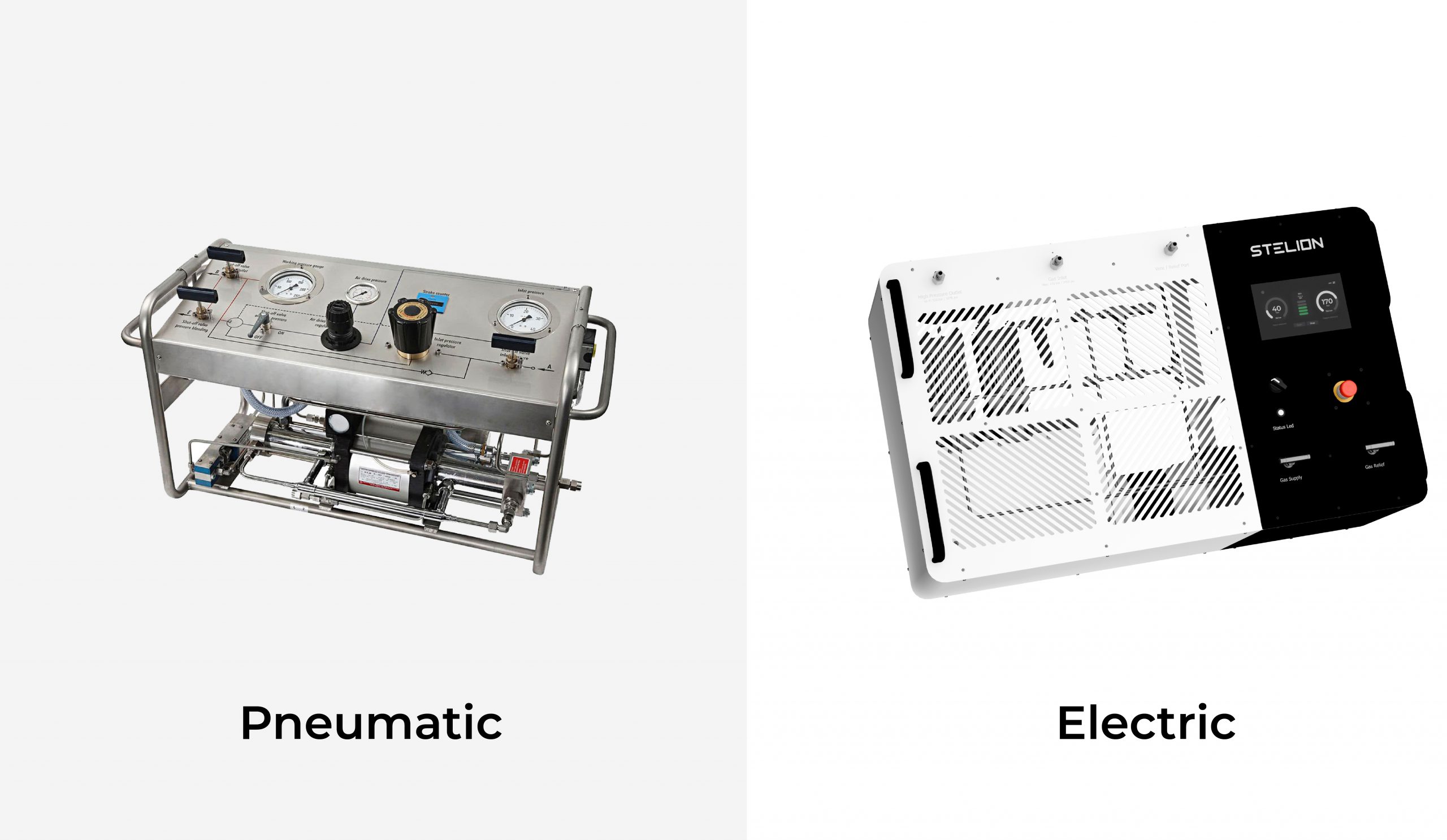
How does a pneumatic gas booster work?
A pneumatic gas booster uses compressed air as its power source. Its mechanism is based on a large-diameter piston, driven by low-pressure air, that is mechanically coupled to a smaller-diameter piston in the gas chamber. The difference in area between the two pistons generates the compression ratio.
The operating cycle is automatic thanks to a spool valve system that reverses the piston direction each time it reaches the end of its stroke. As long as compressed air is supplied, the booster continues to operate. When the pressure equalizes with the driving force of the air piston, the unit stops on its own.
This mechanical simplicity has been its main selling point for years. It requires no electricity, incorporates no electronics and its maintenance is limited to replacing seals and valves as they wear. Furthermore, the absence of electrical components has historically made it suitable for ATEX environments.
However, this simplicity comes with certain drawbacks. The energy chain of a pneumatic booster is long and inefficient. Electricity powers an external air compressor, the compressed air is transported through piping to the booster and, once there, drives the piston responsible for compressing the gas. Energy is lost at every stage of the process. According to a review published in 2024 by Dindorf et al., the overall energy efficiency of a complete pneumatic system falls between 6% and 10%, due to cumulative losses during compression, transport and utilization of the air (Gryboś, D., & Leszczyński, J. S. (2024). A Review of Energy Overconsumption Reduction Methods in the Utilization Stage in Compressed Air Systems. Energies, 17(6))
These inefficiencies are compounded by other limitations, including high noise levels, especially when operating at high flow rates or with multiple units in parallel, the lack of digital controls to monitor and adjust pressure parameters, and the inability to automate the charging process.
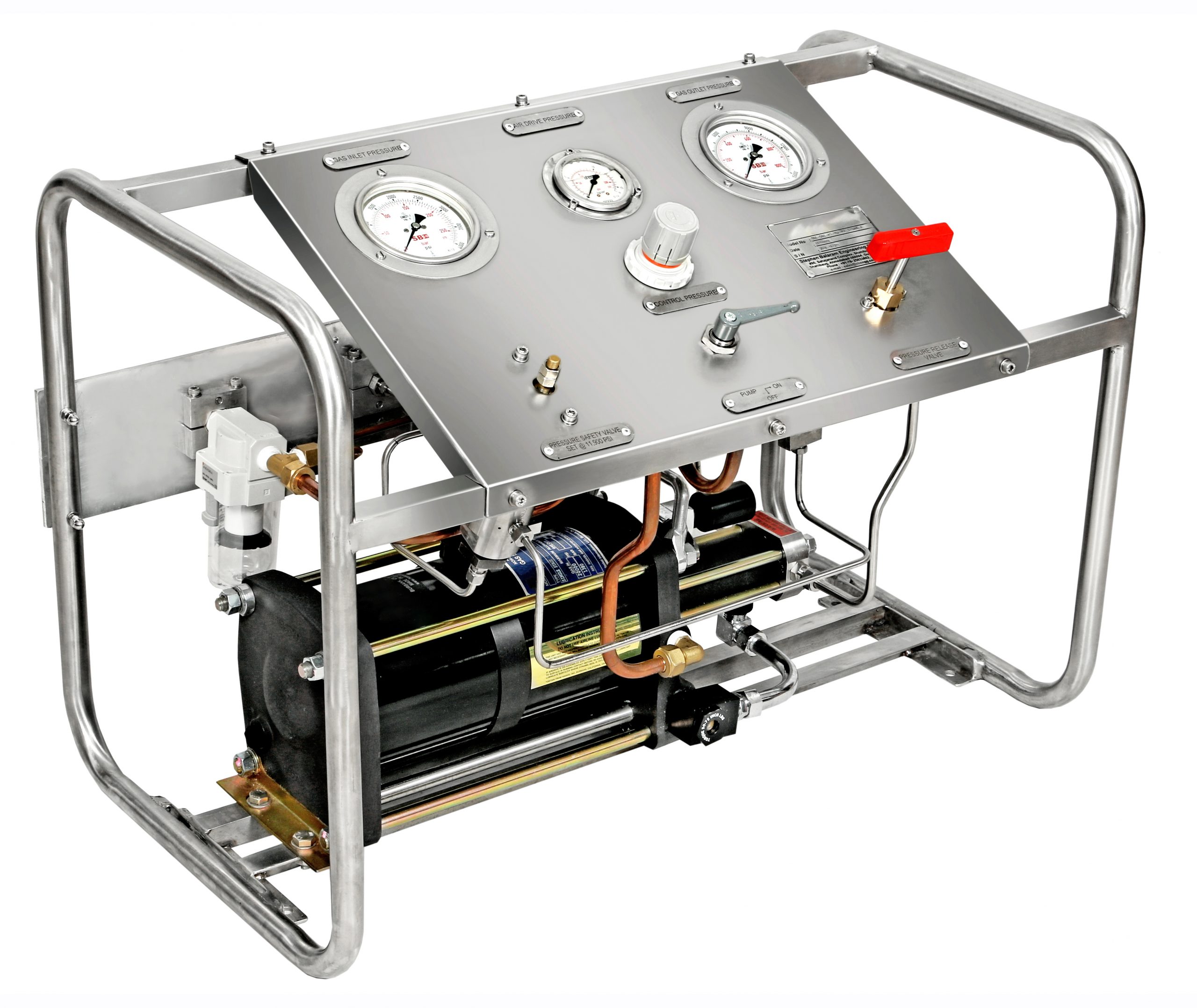
Pneumatic gas booster
How does an electric gas booster work?
An electric gas booster replaces the pneumatic drive with an electric motor coupled directly to the compression piston. This direct connection eliminates the need for an external air compressor, compressed air lines and all the auxiliary infrastructure associated with a pneumatic system.
The energy chain is reduced to a single step. Electricity powers the motor, which drives the piston. As noted by John Crane in an analysis published in 2025, electrically driven gas boosters are more energy effective because the chain from electricity to compressed gas is shorter and does not present the leakage paths inherent in pneumatic systems, which require long stretches of piping to bring in pressurized air.
This simplicity in energy transmission results in significantly higher efficiency, lower heat generation and a noise level far below that of pneumatic systems.
But this is only the starting point. An electric booster opens the door to integrating control and automation capabilities that a pneumatic system, by its very mechanical nature, cannot offer. However, most electric gas boosters available on the market have simply replaced the pneumatic drive with an electric one, without leveraging that potential.
An example of this different approach is STELION Booster Station, developed by Hydros Power. It is a compact electric gas booster pump that integrates a digital interface to configure target pressures, an automatic mode that stops and resumes the charging process according to operator-defined parameters, a power meter to monitor energy consumption and an error management system accessible from the unit itself.
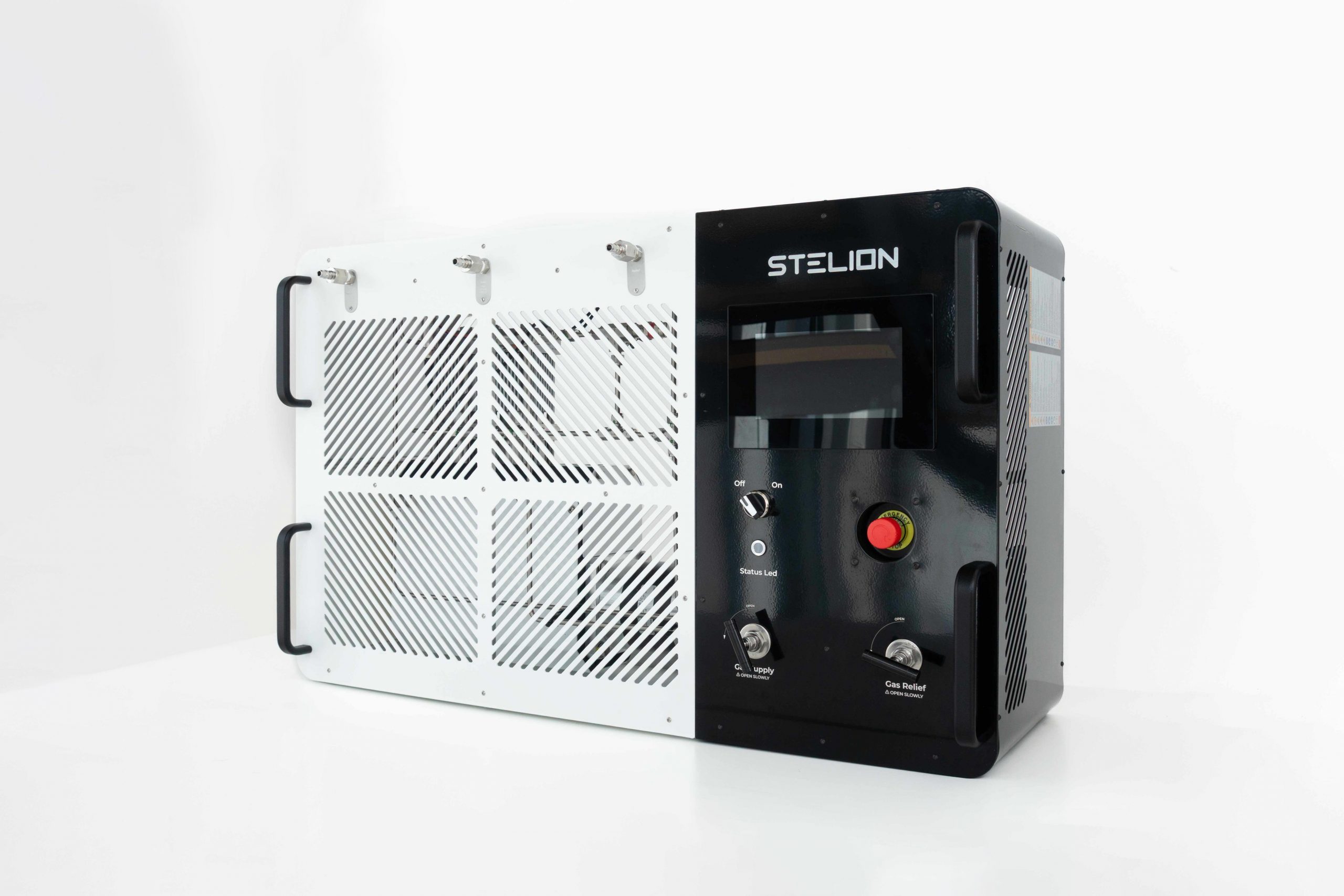
STELION Booster Station electric gas booster pump by Hydros Power
This type of solution represents a shift from the traditional model, turning the gas booster pump into an intelligent piece of equipment capable of delivering traceability, control and automation in every operating cycle.
Electric vs pneumatic gas booster: a direct comparison
| Criteria | Pneumatic gas booster | Electric gas booster |
|---|---|---|
| Power source | Compressed air (requires external compressor) | Electricity (direct connection) |
| Energy efficiency | Low (6–10% estimated for the complete system) | High (80–95% in direct transmission) |
| Auxiliary infrastructure | Air compressor, air lines, air treatment | Electrical connection |
| Noise level | High, especially at elevated flow rates | Low |
| Pressure control | Mechanical (based on force equilibrium) | Digital (parameter configuration via interface) |
| Automation | Limited to the system’s mechanics | Native: automatic modes, programmed stop/resume |
| Monitoring | Not natively available | Integrated (energy consumption, errors, cycle status) |
| Maintenance | Seals and valves (mechanical wear parts) | Lower mechanical wear, less frequent intervention |
| Hydrogen suitability | Requires application-specific material configuration | Designed with compatibility from the outset |
| ATEX certification | Inherent due to absence of electricity | Requires specific design (available in certified units) |
| Acquisition cost | Generally lower | Generally higher |
| Total cost of ownership | Higher (energy consumption, auxiliary infrastructure, maintenance) | Lower over the medium and long term |
Which gas booster is best suited for each application?
There is no universal answer. The choice depends on operating conditions, gas type, frequency of use and project requirements.
A pneumatic gas booster remains a valid option in scenarios where there is no access to an electrical supply, where use is very occasional and sporadic, or where compressed air infrastructure already exists and the marginal cost of adding a booster is low.
However, in applications that require frequent operation, precise pressure control, charging process automation or integration with digital systems, the electric gas booster offers advantages that are difficult to match. This is especially relevant in hydrogen projects, where overall energy efficiency is a critical factor.
Environments such as research laboratories, universities, fuel cell testing centres, light vehicle, drone and UAV refueling operations, or energy deployments in locations without access to a conventional station benefit directly from an electric unit that does not depend on auxiliary infrastructure to operate.
The shift toward electric gas boosters in the hydrogen sector
The hydrogen sector is undergoing a progressive shift toward electric compression solutions, driven by several converging factors.
First, energy efficiency. In an ecosystem where green hydrogen production already involves significant losses during electrolysis, adding a compression stage with an efficiency of 6–10% compounds the problem. A study published by Alfred Rufer, researcher at EPFL (École Polytechnique Fédérale de Lausanne), specifically addresses this issue and describes electrically driven gas boosters as a direct alternative to classical air-driven boosters, whose poor energy efficiency penalizes the overall balance in small-scale hydrogen storage facilities and refueling stations (Rufer, Alfred. (2021). On the efficiency of energy storage systems – the influence of the exchanged power and the penalty of the auxiliaries. Facta universitatis – series: Electronics and Energetics. 34.)
Second, automation and digitalization. Today’s hydrogen projects demand equipment capable of operating autonomously, reporting performance data and integrating into broader monitoring systems. A booster that can only compress gas is no longer enough. The market demands equipment that understands its own process and manages it intelligently.
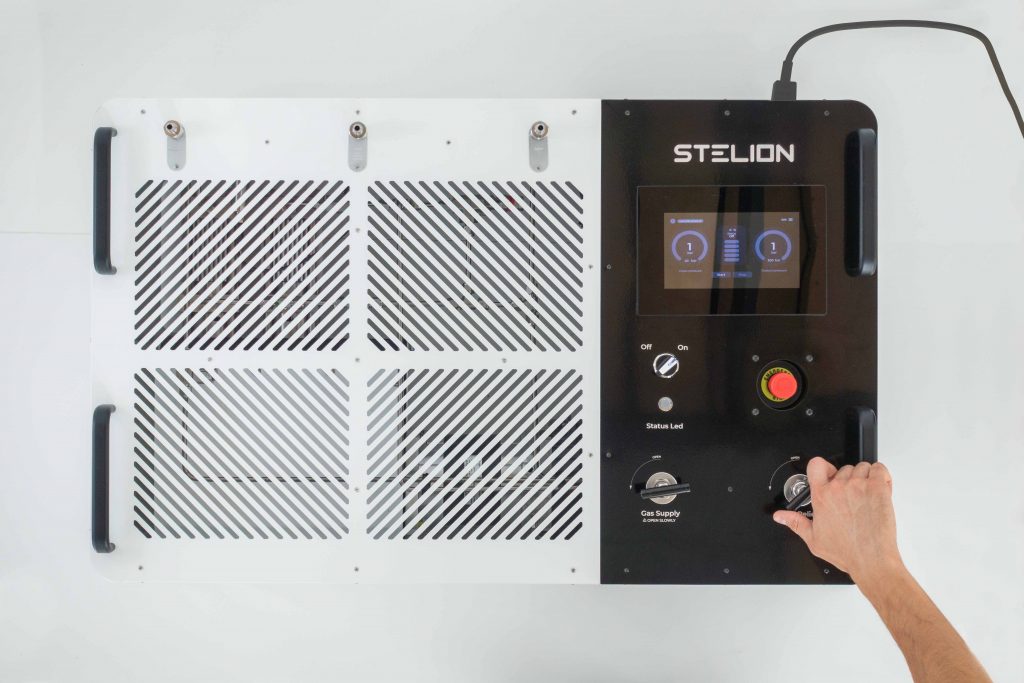
STELION Booster Station digital interface
Third, decentralization. The distributed hydrogen model, where generation and consumption move closer to the point of use, requires compact equipment that is easy to deploy and does not carry the complexity of traditional industrial infrastructure. Solutions such as STELION Booster Station respond to this logic: a certified unit with digital control, ready to operate in environments where conventional infrastructure would be too slow and costly to deploy.
The trend is clear. As hydrogen advances from large industrial installations toward smaller-scale, more diverse and distributed applications, the equipment that supports it needs to evolve in the same direction. In light of its advantages, the electric gas booster is positioned as the technology best prepared to drive the future of hydrogen.
If you are exploring electric gas boosters for hydrogen or industrial gas applications, learn more about STELION Booster Station, its specifications and how it works.
Recent articles

Press contact
For press inquiries or additional information about Hydros Power and its hydrogen solutions, you can contact the team at:
Guillermo Megías Collado
guillermo.megias@hydros-pwr.com
+34 865 642 254