

RED III and heavy-duty transport: what it means for refrigerated logistics
Heavy-duty transport decarbonisation is no longer just about engines and fuels. European renewable energy targets are reshaping the regulatory environment in which vehicle manufacturers, logistics operators and energy suppliers plan their investments.
The Renewable Energy Directive III (RED III) is an important part of this transition. However, its targets do not require transport operators to replace diesel trucks with electric or hydrogen-powered vehicles. Their impact depends on how the legislation is implemented in each Member State and the industrial decisions made by the different stakeholders.
For refrigerated transport, there is another important consideration: the energy required to move a vehicle is not necessarily the same energy used to maintain cargo at the required temperature. Understanding this distinction is essential when assessing decarbonisation options for cold chain logistics.
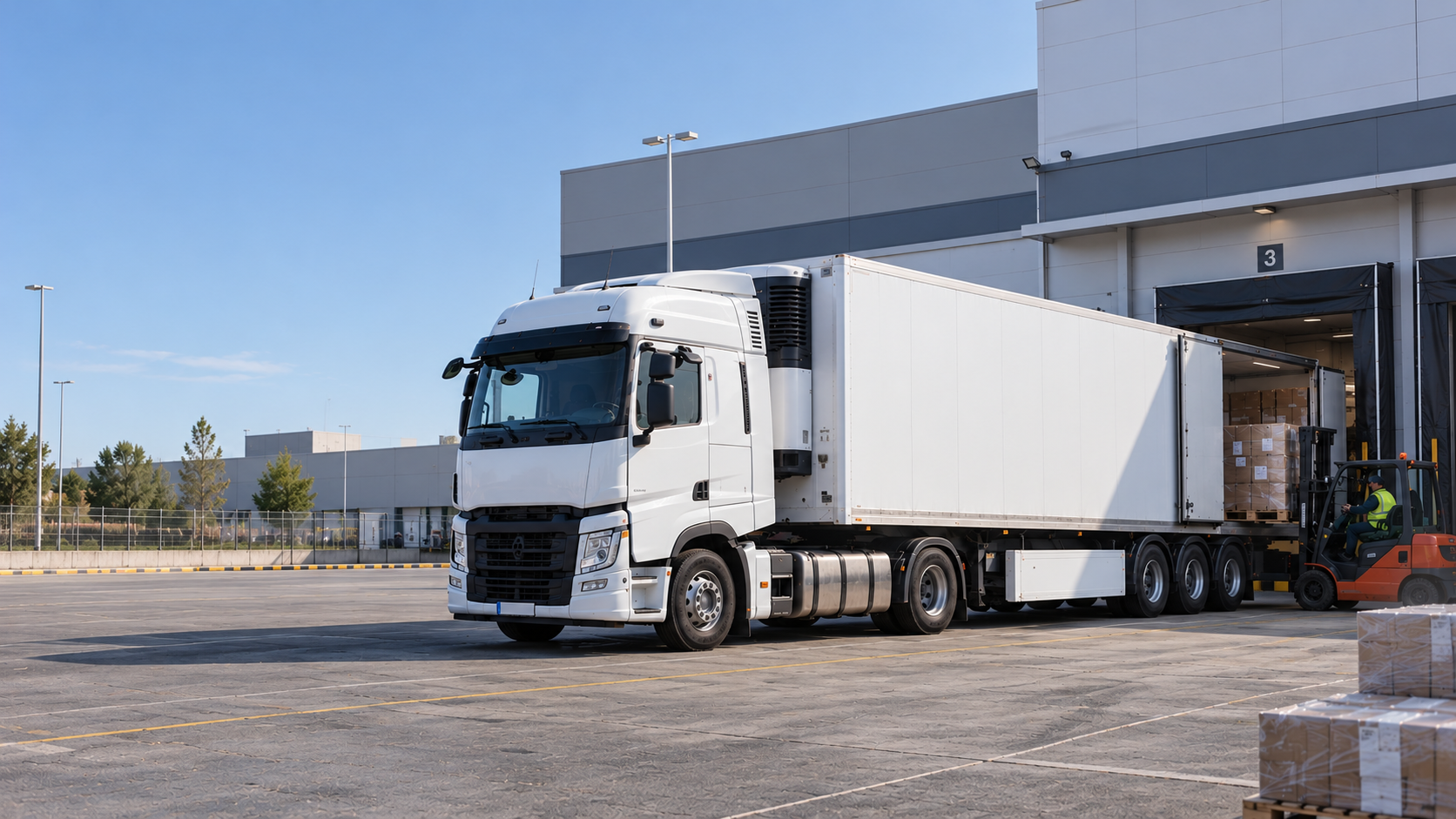
Truck parking area inside an industrial warehouse with a refrigerated truck
What is RED III and why does it matter for transport?
Directive (EU) 2023/2413, commonly known as RED III, amends the European renewable energy framework established by Directive (EU) 2018/2001.
Its overall target is for renewable energy to account for at least 42.5% of the European Union’s gross final energy consumption by 2030, with a collective ambition to reach 45%.
For the transport sector, Article 25 of the Renewable Energy Directive, as amended by RED III, establishes two alternative pathways for national targets by 2030: achieving a minimum 29% share of renewable energy or reducing greenhouse gas (GHG) emissions intensity by at least 14.5% compared with the established reference value.
The Directive also sets a combined 5.5% sub-target for advanced biofuels, biogas produced from specified feedstocks, and renewable fuels of non-biological origin. Within this target, at least one percentage point must come from the latter.
Renewable fuels of non-biological origin (RFNBOs) include certain forms of renewable hydrogen and hydrogen-derived fuels.
However, producing hydrogen through electrolysis does not automatically qualify it as an RFNBO. The applicable regulatory criteria must be met, including requirements concerning the electricity source and, where relevant, additionality and temporal and geographical correlation, as established in Commission Delegated Regulation (EU) 2023/1184.
These European targets are translated into national obligations and compliance mechanisms. They do not impose an individual emissions reduction requirement directly on every transport operator.
RED III implementation in Spain: Road transport targets
RED III establishes a common European framework, but Member States determine how national obligations and compliance mechanisms are organised.
Spain has implemented part of this framework through Royal Decree 611/2026 of 22 July, which introduces decarbonisation targets for different transport modes.
For road transport, Article 9 establishes a progressive reduction in greenhouse gas emissions intensity relative to the fossil fuel comparator. By 2030, this reduction reaches 17.6%.
Article 10 establishes a minimum RFNBO sub-target of 2.5% by energy content for 2030, alongside specific targets for advanced biofuels and biogas.
These figures apply to the Spanish regulatory framework and should not be confused with the general minimum targets established by RED III for the European Union.
The obligations apply to the entities identified in Article 20, including fuel operators, distributors and certain direct consumers under the conditions specified in the legislation. The Royal Decree also provides calculation rules, exemptions and flexibility mechanisms that may affect how compliance is demonstrated.
Although the legislation was published on 23 July 2026 and certain provisions entered into force the following day, the general obligations are scheduled to apply from 1 January 2027.

What does RED III mean for heavy-duty transport and hydrogen?
RED III targets may encourage the adoption of renewable fuels and new energy solutions, but they do not prescribe which technology individual fleets must use.
Decisions to replace or convert heavy-duty vehicles depend on factors such as required driving range, route characteristics, available infrastructure, operating schedules and total cost of ownership.
It is also important to distinguish RED III from other European legislation. Regulation (EU) 2024/1610 strengthens CO₂ emissions reduction targets for new heavy-duty vehicles. Compliance falls to vehicle manufacturers under the applicable rules and vehicle categories.
Both pieces of legislation contribute to the transport energy transition, but they address different aspects. RED III establishes targets relating to renewable energy supply and use, while the CO₂ regulation addresses emissions from new heavy-duty vehicles.
Within this framework, renewable hydrogen may play a role in certain heavy-duty transport applications, particularly where its operating characteristics make it suitable compared with other alternatives.
However, RFNBO targets do not mean that all hydrogen counted towards compliance must be consumed directly by trucks.
The European Commission’s guidance C/2025/2983 explains that certain uses of renewable hydrogen as an intermediate product in refineries, including the production of conventional fuels or biofuels, may contribute towards transport targets, provided the relevant accounting conditions are met.
Consequently, an increase in regulatory demand for RFNBOs does not, by itself, indicate how many hydrogen-powered vehicles will enter service on European roads.
For logistics operators, the challenge is to identify energy solutions that reduce emissions without compromising operational requirements. In refrigerated transport, this assessment must account for an additional energy demand beyond vehicle propulsion.
Refrigerated transport: the energy challenge of refrigeration units
A refrigerated vehicle requires energy not only for propulsion but also to maintain cargo at the required temperature during journeys, stops and certain loading and unloading operations.
These two functions may rely on separate energy systems.
In many configurations, particularly refrigerated semi-trailers, the transport refrigeration unit (TRU) has its own diesel engine, operating independently of the vehicle’s propulsion system. Other configurations draw energy from the vehicle or use an external electricity supply.
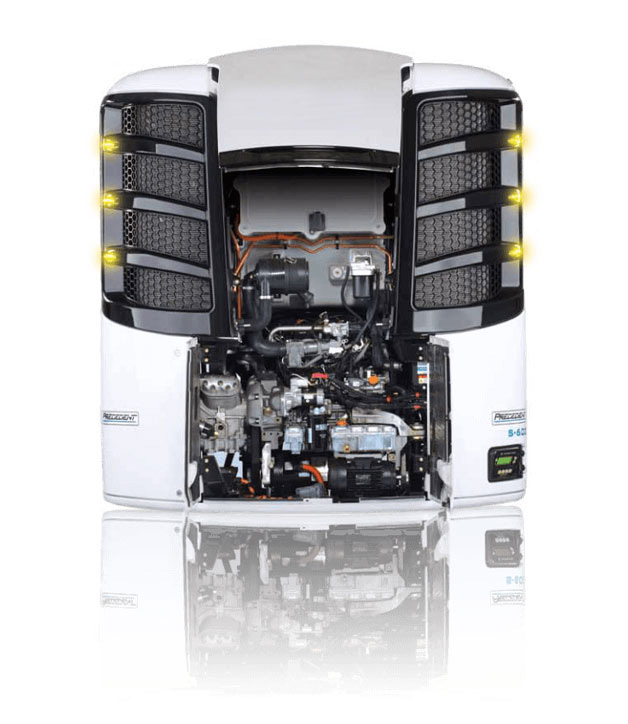
Diesel-powered transport refrigeration unit. In many refrigerated semi-trailers, refrigeration operates independently of the truck’s propulsion system.
This means that electrifying a truck’s powertrain does not necessarily eliminate diesel consumption associated with refrigeration.
The importance of this distinction is reflected in the 2026 study The EU road refrigerated transport: current GHG footprint of transport refrigeration unit and projected impact of sustainable technologies, published in the International Journal of Refrigeration.
The study presents a sector-level estimate of greenhouse gas emissions from refrigerated road transport for 2021. Within the emissions considered, approximately 20% were attributed to the energy consumption of transport refrigeration units.
This figure must be interpreted within the scope and assumptions of the study. It does not necessarily represent the emissions breakdown of an individual vehicle, route or fleet, and should not be treated as a fixed percentage applicable to all European heavy-duty transport.
The research also examines the potential of different technologies to reduce the energy demand and environmental impact of transport refrigeration.
Refrigeration therefore represents a distinct area within refrigerated transport decarbonisation, with its own requirements for continuous energy supply, power availability, reliability and cargo temperature control.
Which technologies can decarbonise transport refrigeration?
Several technologies can reduce reliance on diesel engines powering transport refrigeration units. No single solution is necessarily the most suitable for every operating scenario.
External electrical supply and battery systems
An external electricity supply can power compatible refrigeration units during stationary operations, such as those at logistics centres, warehouses and terminals. Its use depends on the availability of suitable electrical infrastructure wherever the vehicle operates.
Battery systems extend electric operation beyond fixed locations. Their sizing depends on the refrigeration unit’s power demand, operating duration, charging times and available energy capacity.
For certain distribution services, batteries may provide an appropriate solution. In longer operations, energy autonomy and access to charging infrastructure become more significant considerations.
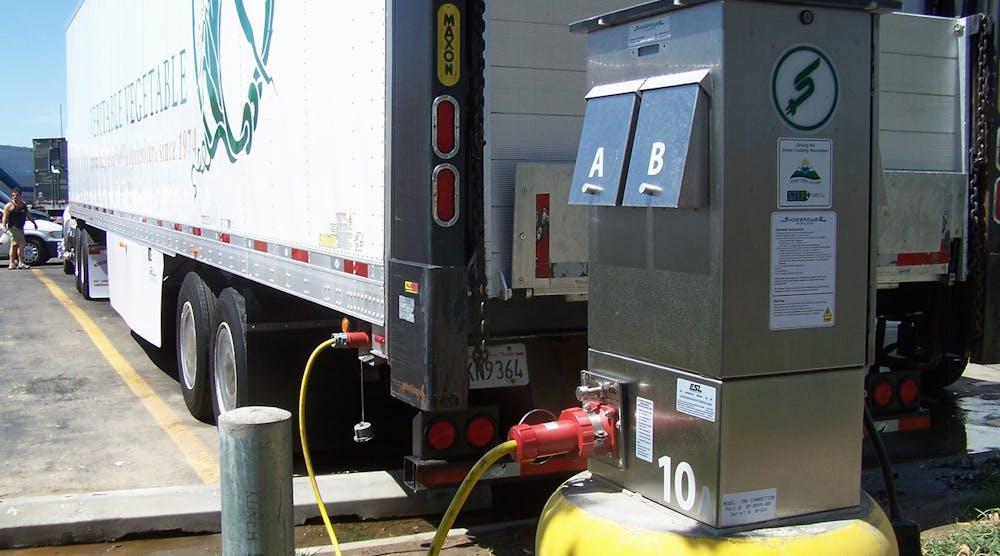
External electrical power can supply compatible transport refrigeration units. Image source: FleetOwner.
Energy recovery and hybrid solutions
Another approach is to use energy available from the vehicle itself, through electrical systems connected to the drivetrain, energy recovery technologies or other compatible configurations.
Their performance depends on driving conditions, vehicle architecture and the refrigeration system’s energy demand.
Hybrid solutions can combine different energy sources or incorporate storage to manage variations in demand and periods of stationary operation.
These alternatives must be assessed at system level: reducing the use of an independent diesel engine does not necessarily eliminate all emissions associated with energy supply.
Hydrogen fuel cell systems
Hydrogen fuel cells generate electricity that can power electrical equipment, including compatible transport refrigeration units.
They may be of interest in applications requiring energy over extended periods or where operational constraints make certain battery-only configurations difficult to implement.
Their viability depends on factors such as hydrogen availability, onboard storage, electrical integration, maintenance and type-approval requirements.
The origin of the hydrogen must also be considered, as emissions associated with its production and supply influence the solution’s overall environmental performance.
Ultimately, there is no universally suitable technology for every refrigerated transport operation. The choice should be based on the actual energy demand profile, logistics requirements and a technical and economic assessment of the complete system.
STELION Powertrain: Hydrogen-powered transport refrigeration
One area of technological development focuses on replacing the diesel-powered electricity source of a transport refrigeration unit with an alternative system capable of supplying electrical power while retaining the existing refrigeration equipment.
This approach makes it possible to address the energy source without necessarily replacing the refrigeration system itself.
Hydros Power is working towards this objective through STELION Powertrain, a hybrid system combining a hydrogen fuel cell and a battery to supply electricity for transport refrigeration applications.
The company has completed proof-of-concept trials with Grupo FTM and Grupo Torres to evaluate the integration of hydrogen-based energy systems into transport refrigeration equipment.
STELION Powertrain remains under development and is not yet generally commercially available.
The use of a fuel cell should not be confused with automatic compliance with RED III. These are separate matters: one concerns electricity generation technology, while the other relates to regulatory targets and specific criteria for renewable energy and fuels.
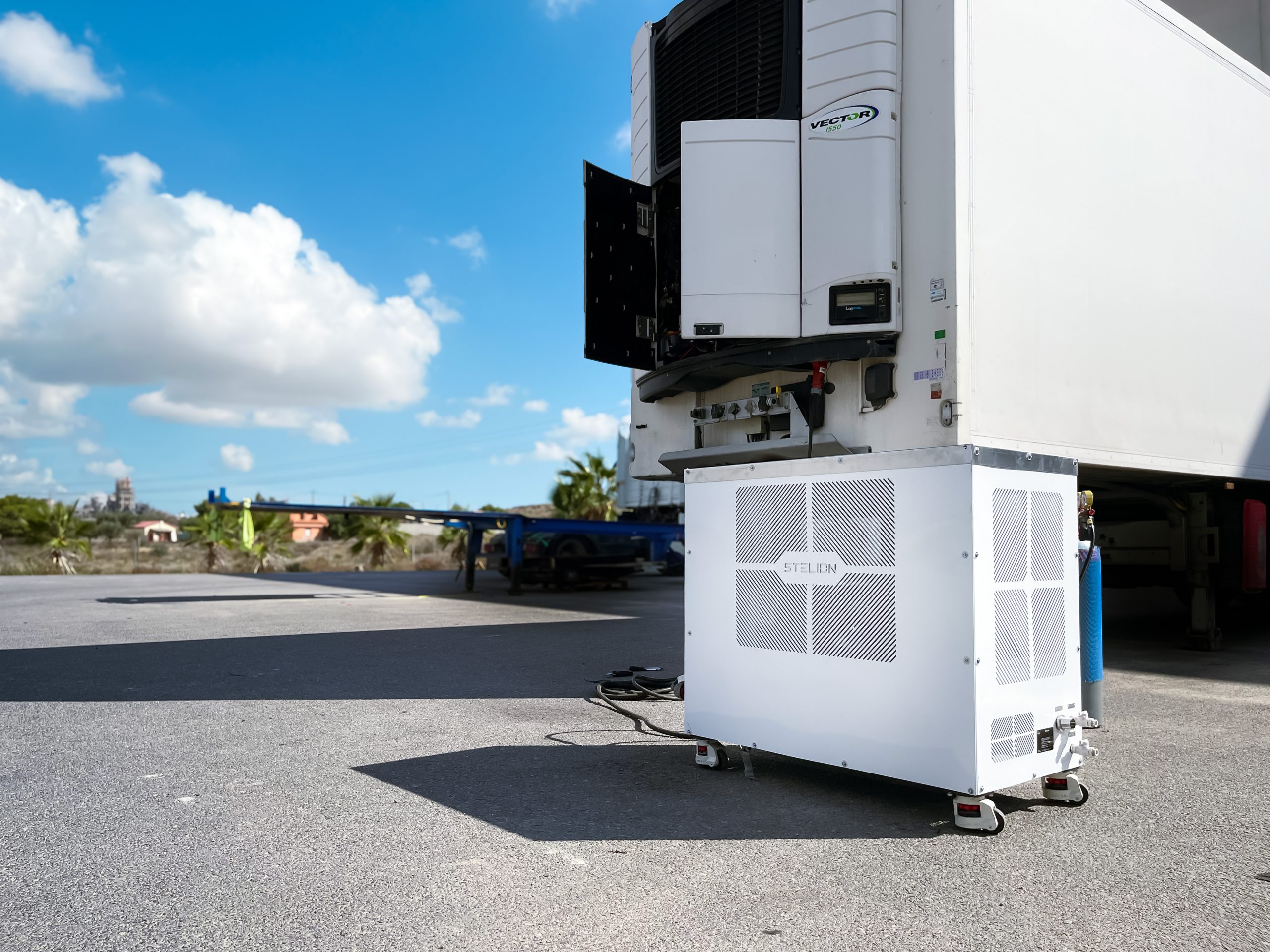
Refrigerated trailer used in Hydros Power’s proof-of-concept project to evaluate a hydrogen fuel cell and battery system for transport refrigeration
Decarbonising transport also means decarbonising refrigeration
RED III is helping reshape the European transport energy landscape, but reducing emissions from refrigerated logistics requires attention to all significant energy demands of a vehicle.
Refrigeration is one of those demands, with its own technical and operational requirements. The challenge is to develop and validate solutions capable of reducing emissions without compromising cargo preservation or service continuity.
Are you exploring alternatives to diesel for powering your fleet’s refrigeration units? At Hydros Power, we are developing hydrogen-based energy solutions for refrigerated transport. If you are a logistics operator, manufacturer or system integrator interested in exploring potential collaborations, contact our team.
Recent articles
November 25, 2026
RED III and heavy-duty transport: what it means for refrigerated logisticsNovember 20, 2026
Nitrogen gas booster pumps: industrial applications and when higher pressure is neededOctober 27, 2026
Hydrogen cylinder filling with a gas booster pump: pressure, flow rate and system designOctober 20, 2026
Hydros Power launches €250,000 bridge funding round to support its next stage of industrial growthOctober 19, 2026
Hydros Power introduces STELION Gas Cooler for post-compression hydrogen cooling



Press contact
For press inquiries or additional information about Hydros Power and its hydrogen solutions, you can contact the team at:
Guillermo Megías Collado
guillermo.megias@hydros-pwr.com
+34 865 642 254
03008, Alicante (Spain)
28020, Madrid (Spain)


